





For people searching for a Discord alternative for small groups, the real question is not which platform has more features. The more important question is which platform helps people feel like they truly belong.
Online Tribes, Discord, and Facebook Groups can all gather people around a shared interest, but they create very different emotional experiences. One feels like a curated circle, one feels like a live hangout, and one feels like a large public square with pockets of familiarity.
Why belonging matters
Small groups work best when members feel noticed, remembered, and connected to a shared identity. In communities like these, belonging grows when participation feels human instead of performative and when people feel that their presence actually changes the room.
That is why the best Discord alternative for small groups may not be the platform with the most channels or the biggest audience. It may be the one that creates the strongest sense of emotional consistency over time.
Online Tribes
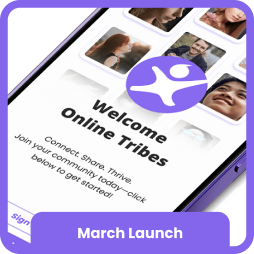
Online Tribes is built around the idea that people do not just want access to other people; they want a smaller circle where connection can deepen over time. The user context around Online Tribes emphasizes small, high-touch tribes, emotional onboarding, strong leaders, recurring rituals, and the idea that absence should be noticeable rather than ignored.
That changes the feeling of the space. Instead of entering a large room and trying to be heard, members enter a more intentional environment where the group identity is part of the product itself.
For small groups, this matters a lot. Belonging is easier to build when there is enough repetition for names, stories, and habits to become familiar. Online Tribes leans into that by positioning the group as something closer to a real-world circle than an open-ended feed.
Its strongest emotional advantage is focus. The platform is not trying to be a giant everything-app for every kind of interaction. It is trying to make a small group feel meaningful enough that members see it as part of their identity, not just another tab on their phone.
Discord
Discord is often the default choice for online communities because it makes conversation feel live, active, and always available. Small servers can create strong bonds, especially in gaming, hobby, and creator communities where shared language and shared rituals emerge naturally.
That live energy is Discord’s strength. It can make a group feel like an always-open room where people can drop in, joke around, and build familiarity over time.
But for small-group belonging, Discord also has a clear weakness. Even when a server starts small, its structure tends to reward activity, speed, and constant presence. That can create closeness for highly active members, but it can also make quieter members feel invisible or late to the conversation.
Discord is excellent for momentum, but it is less reliable for emotional depth. Many communities thrive there, yet the platform itself does not naturally slow people down or guide them toward more intentional connection. Without strong community design, it can become another stream of messages where belonging depends on who is online at the right time.
Facebook Groups
Facebook Groups remains powerful because so many people are already there. That lowers the friction to join and can make groups feel familiar from the start, especially for local communities, parent circles, neighborhood groups, and identity-based communities.
This creates a type of belonging rooted in convenience and proximity. People join because they already use Facebook, and the group becomes an extension of existing online behavior rather than a distinct social ritual.
For some groups, that works well. A local parenting circle or neighborhood community can feel useful and warm because members share real-world context.
Still, Facebook Groups often struggles to create the feeling of a protected inner circle. The surrounding Facebook environment is built around feeds, notifications, and broad distribution, so the group often feels like one stop inside a much larger attention machine.
That means belonging can become shallow. Members may check in, react, or comment, but the platform does not naturally signal that the group itself is a special social container. It is easier to gather people there than to make them feel deeply attached to one another.
How each one feels
The emotional difference between these platforms becomes clearer when viewed through the lens of belonging rather than features.
| Lens | Online Tribes | Discord | Facebook Groups |
| First feeling | Intentional circle | Live hangout | Familiar public square |
| Social rhythm | Repeated and guided | Fast and ongoing | Casual and feed-driven |
| Identity effect | “This is my people” energy | “This is where I hang out” energy | “This is a useful group I follow” energy |
| Best for | Deep connection in small circles | Active real-time communities | Broad reach and easy participation |
Which is best for small groups?
If the goal is activity, Discord is often the easiest choice because it makes interaction feel immediate and alive. If the goal is reach and easy discovery, Facebook Groups still has a major advantage because people already live inside that ecosystem.
But if the goal is belonging, Online Tribes has the clearest positioning. The product idea is centered on depth, repeated contact, and emotional continuity rather than scale or noise, which makes it a stronger answer for people specifically looking for a Discord alternative for small groups.
This distinction matters because small groups do not usually fail from lack of tools. They fail when members never shift from audience to attachment. Online Tribes appears designed around making that shift happen on purpose.
Final angle
A lot of community platforms help people gather. Fewer help people feel claimed by a group.
Discord is strong when people want energy, speed, and a sense of shared online presence. Facebook Groups is strong when people want access, familiarity, and low friction. Online Tribes is strongest when the goal is to make a small group feel emotionally meaningful enough that people return not just for content, but for connection.
That is why, for the search query “discord alternative for small groups,” the most persuasive comparison is not about channels, threads, or notifications. It is about which platform helps a person say, “these are my people,” and mean it.